The financial system is entering a new chapter—one in which money, assets, and the infrastructure connecting them are becoming increasingly programmable and interoperable.
For years, digital-asset discussions have centered on stablecoins: how they move, how quickly they settle, and how they connect traditional finance with blockchain networks. But stablecoins are only part of a broader transformation.
Circle's report, Beyond Stablecoins: The Rise of the Internet Financial System, describes that emerging future. For credit unions and community banks, the implications extend beyond faster payments to how financial institutions govern new capabilities and deliver them to members.
A New Foundation for Financial Services
Circle's report describes a vision in which programmable infrastructure, digital assets, and applications increasingly work together. Arc is one part of that emerging architecture; stablecoins and tokenized instruments provide digital forms of value; applications connect those capabilities to the needs of real people and institutions.
For a credit union or community bank, these developments could support more efficient payments, new forms of collateralized lending, and new ways to administer financial assets. But access to a network alone does not mean a financial product is ready to operate within a regulated institution.
Why Financial Infrastructure Still Needs Institutional Governance
A payment can settle quickly and still require scrutiny. An asset can be tokenized and still require eligibility checks. A transaction can be technically valid and still fall outside an institution's operating policy.
Financial institutions must establish who may initiate an activity, which approvals apply, what risk thresholds must be met, and how outcomes can be examined later. Those responsibilities persist when the execution environment becomes programmable.
This creates a distinct infrastructure need: a consistent governance layer between institution-owned decisions and the providers that execute those decisions.
The Role of an Institutional Control Plane
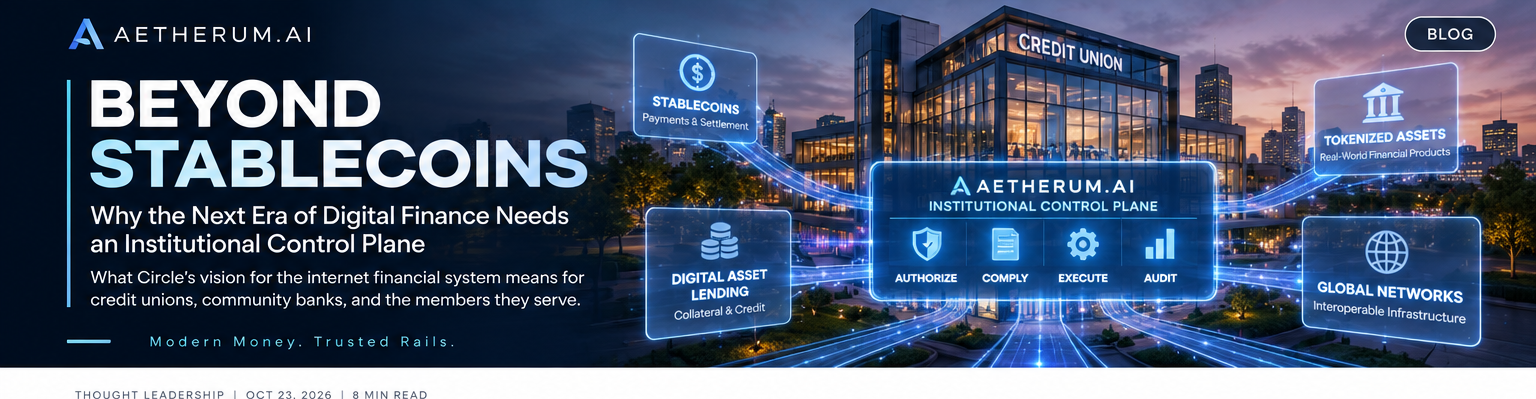
Aetherum.ai is developing software to help regulated institutions govern, authorize, execute, and audit digital-asset activity within institution-controlled workflows.
Our approach separates institutional authority from transaction execution. The institution sets the rules and approves eligible activity. The control plane evaluates identity, permissions, applicable policies, risk conditions, and approvals. Authorized instructions can then be passed to supported execution infrastructure, with transaction outcomes returned for reconciliation and audit evidence.
This approach spans institutional identity and authorization, pre-execution policy controls, digital-asset lending and collateral risk, stablecoin settlement orchestration, tokenized-asset governance, and audit-native compliance. These are interconnected parts of an institutional operating model—not a replacement for the institution's own judgment.
What Changes for Credit Unions and Community Banks
Consider a digital-asset-backed loan. The institution needs more than a wallet connection or collateral transfer. It needs to determine collateral eligibility, establish lending terms, assess risk, authorize a disbursement, monitor collateral conditions, and retain records that explain the decisions made along the way.
The same principle applies to stablecoin payments. Faster settlement may improve the movement of money, but the bank or credit union still needs controlled initiation, approvals, exception handling, reconciliation, and reporting.
Tokenized financial products introduce further questions about who can issue, hold, transfer, pledge, or redeem assets. Institutional governance gives those questions a consistent place in the workflow rather than leaving them to disconnected applications.
The Member Benefit
Digital-asset technology matters most when it improves financial services for people and businesses.
For a member holding eligible digital assets, institution-approved collateralized lending could provide a potential financing option without an immediate sale of those assets. For a small business, improved settlement infrastructure could eventually enable more efficient approved payments and clearer transaction visibility. For members exploring new forms of digital finance, the institution could remain a familiar point of service and accountability.
These are potential use cases, not guarantees of availability. Product eligibility, institutional approval, legal requirements, and financial risks—including collateral price volatility—must all be considered.
The objective is not to displace the credit-union or community-bank relationship. It is to expand what that relationship can responsibly deliver.
Why Interoperability Matters
The digital-asset ecosystem will not consist of a single execution network, wallet platform, or settlement provider. Circle's USDC and Arc initiatives illustrate one important direction; other providers are building complementary infrastructure.
Institutional policy should not need to be reinvented whenever a provider changes. A provider-neutral control plane is designed to preserve consistent identity, approval, risk, and audit processes across supported integrations.
Aetherum's development includes policy, identity, risk, and evidence components, and an ongoing Polygon OMS integration intended to demonstrate a complete institutional execution and reconciliation workflow. Work involving Circle technologies informs our evaluation of complementary settlement environments. We do not present prospective Arc integration as deployed production functionality.
From Programmable Money to Accountable Financial Activity
As software handles more financial instructions, accountability becomes more—not less—important.
An institution needs to establish who initiated a transaction, what authority they had, which policies were evaluated, whether approval was granted, what executed, and how the final outcome was reconciled. Denied or interrupted activity should also leave a meaningful record.
Circle's ecosystem already includes policy-controlled wallets and other control capabilities. The distinct institutional question is how permissions, decisions, and evidence stay coherent across an institution's diverse financial workflows and multiple providers.
The Road Ahead
The emerging internet financial system will develop through collaboration among financial institutions, technology providers, regulators, and the people who rely on financial services.
Stablecoins may change how value moves. Programmable networks may change how financial assets interact. Institution-controlled governance can help turn those capabilities into responsible financial services.
At Aetherum.ai, our focus is helping credit unions and community banks participate without surrendering authority over risk, approvals, operating policies, or member relationships.
Modern Money. Trusted Rails.